Clothing and Accessories · Culture & Everyday Style
When Knitwear Signals Belonging: Cultural Dress Norms and Everyday Layers
A cardigan can suggest ease in one room and polish in another. A knitted cap may be a practical answer to cold weather, a familiar part of a local uniform, or simply a personal choice. Knitwear is rarely just about warmth: its meanings form at the intersection of place, occasion, work, history, and the people who wear it.
The quiet language of a familiar layer
Some garments announce themselves. Others make their point through repetition. Knitwear belongs largely to the second category. A sweater thrown over a shirt, a cardigan worn open at a desk, a beanie pulled down against the wind: these are ordinary acts, which is precisely why they can carry such complicated signals. They tell observers something about the weather, perhaps, but also about how a person understands the moment.
In one setting, a soft pullover reads as relaxed and approachable. In another, the same garment may look underdressed beside tailored jackets and formal shoes. A fine-gauge cardigan can feel appropriate for a meeting, while a bulky, patterned sweater might be associated with weekends or outdoor work. Neither interpretation is built into the wool or the stitches. It emerges from shared expectations—sometimes explicit, often learned by watching what others wear.
That makes knitwear a useful lens on cultural dress norms. It sits close to the body, adapts readily to changing temperatures, and appears in settings ranging from homes and classrooms to offices, ceremonies, and public streets. Its familiarity can make its social meaning easy to overlook. Yet a small shift in texture, fit, color, or context can change how a layer is read.
There is no universal dress code for a cardigan or sweater. Norms vary between communities, generations, workplaces, climates, and individual households. A thoughtful approach begins by noticing those differences without assuming that one group’s habits speak for everyone in it.
Dress codes are written—and unwritten
Formal dress codes tend to name recognizable categories: business attire, uniforms, smart casual, or clothing suitable for a particular ceremony. Everyday expectations are less tidy. A workplace may never state whether knitwear is acceptable, but employees still learn which garments appear to belong in its rooms. A school may permit sweaters while signaling, through color and cut, which ones fit its preferred image. In a family, a particular cardigan may be understood as practical, presentable, or reserved for a special occasion.
These informal rules are not necessarily deliberate. They develop through repetition and social feedback. People see what colleagues wear, notice what is praised or corrected, and make adjustments. In many environments, knitwear is considered less formal than a structured jacket. But that shorthand can mislead. A neat, fine-knit layer with a considered fit may look composed; an elaborate cable-knit garment may be valued for its craft and still seem out of place in a setting that expects a suit.
Interpretation also depends on the rest of an outfit. A cardigan over a crisp shirt and tailored trousers carries a different impression from the same cardigan worn with a T-shirt and loose denim. The wearer’s manner, the garment’s condition, and the occasion all contribute. Clothing is read as a whole, not as a dictionary in which each item has one fixed definition.
For anyone navigating an unfamiliar environment, the useful question is not simply, “Is a sweater formal?” It is, “What does this particular setting consider appropriate, and how much room is there for personal variation?” Observing the local pattern can help, but asking a trusted host or colleague may be clearer than treating an assumption as a rule.
Comfort is cultural, too
Knitwear is often described as comfortable, but comfort is not a universal measurement. It can mean softness, warmth, freedom to move, modest coverage, a sense of familiarity, or confidence that a person is dressed suitably. A lightweight cardigan may feel reassuring in an air-conditioned office, while a thick sweater becomes cumbersome in a heated room. Someone who prefers breathable cotton may find wool irritating; another person may prize wool’s warmth and resilience.
Practical conditions shape what feels wearable. Climate matters, but so do buildings, commutes, transit, and routines. Someone moving between a cold outdoor street and a warm indoor workspace may value a layer that can be opened or removed. A person whose day involves physical work may prioritize stretch and durability. For others, a familiar knit offers continuity through a busy day, an important meeting, or a change in season.
Comfort can also be social. A garment may help someone feel at ease among peers, or it may draw attention because it departs from local expectations. Neither response proves that the clothing is inherently appropriate or inappropriate. It reveals how personal preference meets a community’s shared habits. Those habits can be welcoming, restrictive, or a mixture of both.
When discussing dress, it is worth resisting the idea that “comfortable” means “careless.” A person can choose a soft, relaxed layer thoughtfully. Equally, a polished appearance does not require discomfort. The most useful wardrobe decisions account for a person’s body and needs while recognizing the occasion and the expectations that matter in that setting.
Belonging, identity, and the meaning of a layer
Clothing can signal affiliation without being a uniform. A familiar color, a particular kind of knit, or a style commonly worn in a community may help a person feel connected to others. This does not mean that every garment has a fixed cultural meaning, or that an observer can reliably infer someone’s identity from a sweater. It means that clothing participates in the ordinary work of recognition: people notice what feels familiar, what is shared, and what differs.
Belonging may be tied to routines as much as to symbols. A cardigan associated with a school or workplace, a knitted garment made by a relative, or a beanie worn through many winters can gather meaning over time. The garment becomes part of a personal history. Its significance may be invisible to strangers, yet unmistakable to the person who wears it.
Regional textile traditions add another dimension. Knitting and related crafts have developed in varied places under different conditions, shaped by available fibers, local economies, weather, techniques, and patterns of exchange. Some styles are recognized well beyond the communities in which they developed. That visibility can bring appreciation, but it can also flatten a complex history into a generic fashion reference. A respectful account names a tradition accurately where possible and avoids treating a regional style as a costume or an interchangeable decorative motif.
Fashion travels quickly; context does not always travel with it. A pattern or silhouette may move from one place to another through trade, migration, media, and design. People may wear it for warmth, beauty, personal connection, or no particular reason beyond liking it. Curiosity is more useful than presumption: ask about a garment’s origins when appropriate, seek reliable sources, and leave room for different relationships to the same style.
Climate and the practical intelligence of layering
Layering is not only an aesthetic choice. It is a way of responding to fluctuating conditions. A base layer, a shirt, and a cardigan can be adjusted over the course of a day more easily than a single heavy garment. Open-front styles provide one kind of flexibility; pullovers and close-fitting knits provide another. The best arrangement depends on temperature, activity, and how much movement a person needs.
Regional weather influences what is readily available and commonly worn, but climate alone cannot explain local dress. Heating and cooling systems, access to suitable clothing, work requirements, and customs all shape decisions. A warm garment may be essential outdoors yet unnecessary indoors. In a crowded or air-conditioned environment, a light layer may serve as much for temperature control as for presentation.
Material and construction affect how a knitted piece behaves. Wool is valued for warmth, while cotton often feels lighter and more breathable. Alpaca can provide warmth with relatively little weight; blends may combine qualities such as softness, durability, or drape. These are general tendencies, not guarantees. Yarn, knit density, garment shape, and the wearer’s own sensitivity all matter. Care labels and fiber information help set practical expectations.
Good layering also respects movement. Sleeves that bunch beneath a coat, a hem that rides up, or a bulky collar competing with a scarf can turn a visually appealing outfit into an uncomfortable one. Considering the full day—commute, work, temperature changes, and indoor settings—often leads to a more useful choice than dressing for a single moment.
Workplace expectations and the adaptable cardigan
Workplaces are among the clearest examples of clothing norms in action. Some are explicit about uniforms or professional dress. Others leave room for interpretation, creating a quiet process of calibration. Employees may look to managers, clients, or established team habits to understand where knitwear fits. The answer can differ between a studio, a classroom, a laboratory, a shop floor, and a formal office.
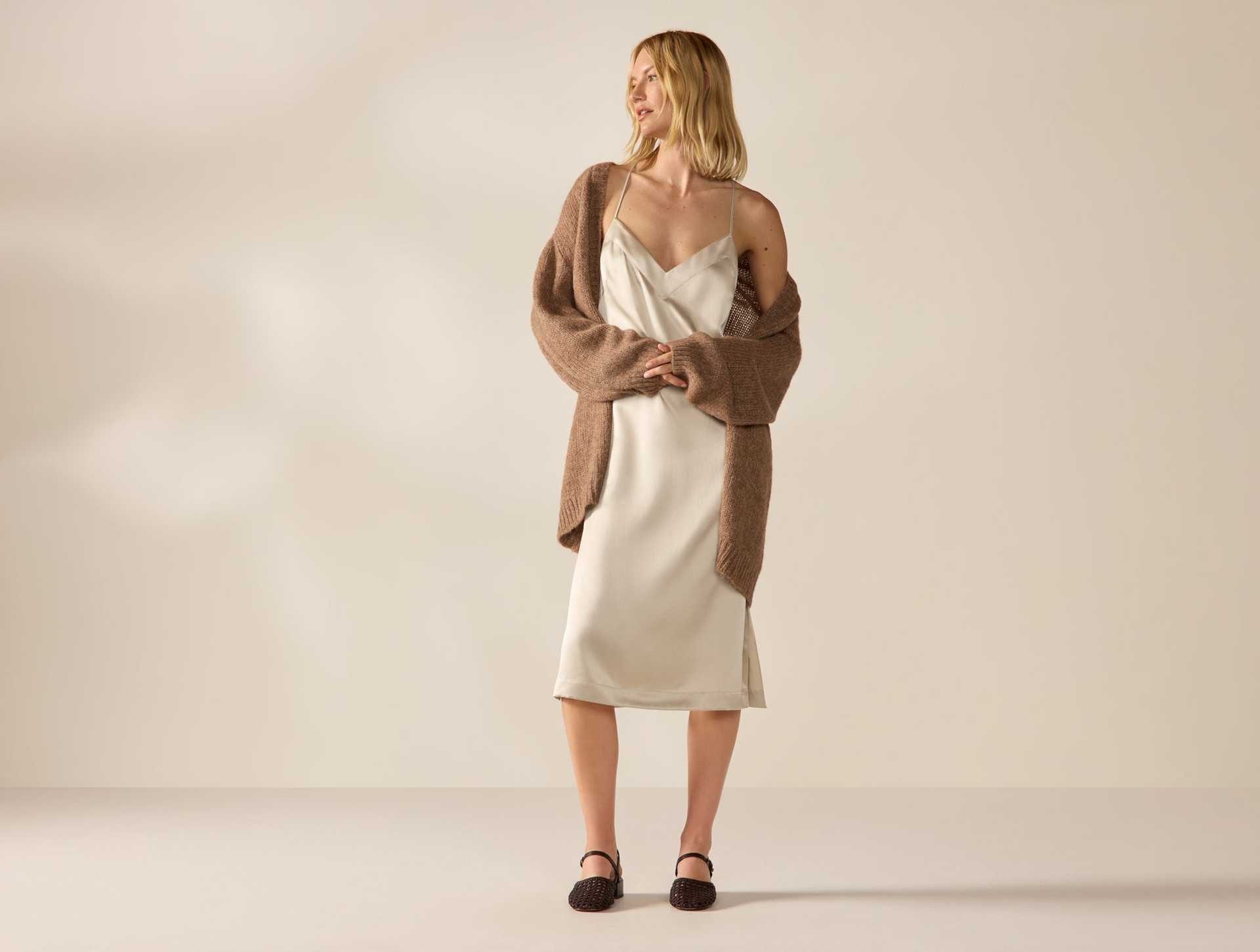
A cardigan is especially adaptable because its form can sit between casual and structured. A clean silhouette and restrained detailing may complement more formal clothing; a relaxed fit and pronounced texture may feel at home in a less formal environment. Yet there is no single formula. A highly formal workplace may expect a jacket, while another may consider a cardigan entirely appropriate. Local expectations, not a universal ranking of garments, determine the practical answer.
Dress norms can also carry unequal consequences. People may be judged differently for the same clothing based on gender, age, body size, occupation, or perceived cultural background. A rule described as neutral may be enforced unevenly, and assumptions about what looks “professional” can reflect narrow ideas about presentation. Recognizing this does not require dismissing every dress standard. It does require asking whether a rule is clear, relevant to the work, and applied consistently.
For managers and teams, clarity is kinder than guesswork. If a workplace has expectations for meetings, client-facing roles, or safety equipment, state them plainly and distinguish practical requirements from aesthetic preferences. For individuals, a reliable approach is to observe the setting, consider the day’s responsibilities, and choose a layer that feels both functional and suitably composed.
A beanie: utility, style, and public visibility
Headwear makes the relationship between practicality and social meaning especially visible. A knitted beanie may be worn to retain warmth, protect against wind, or complete an outfit. In a school, workplace, or indoor event, however, expectations about removing hats may apply. A garment that feels indispensable outdoors can become a question of etiquette once its wearer crosses a threshold.
Those expectations vary. Some indoor spaces ask guests to remove headwear as a sign of respect; others make exceptions for religious practice, health, comfort, or personal circumstances. It is unwise to assume that every hat has the same meaning, or that a rule can be applied without regard to why someone is wearing it. When uncertain, a discreet question or a clear, considerate policy can prevent needless embarrassment.
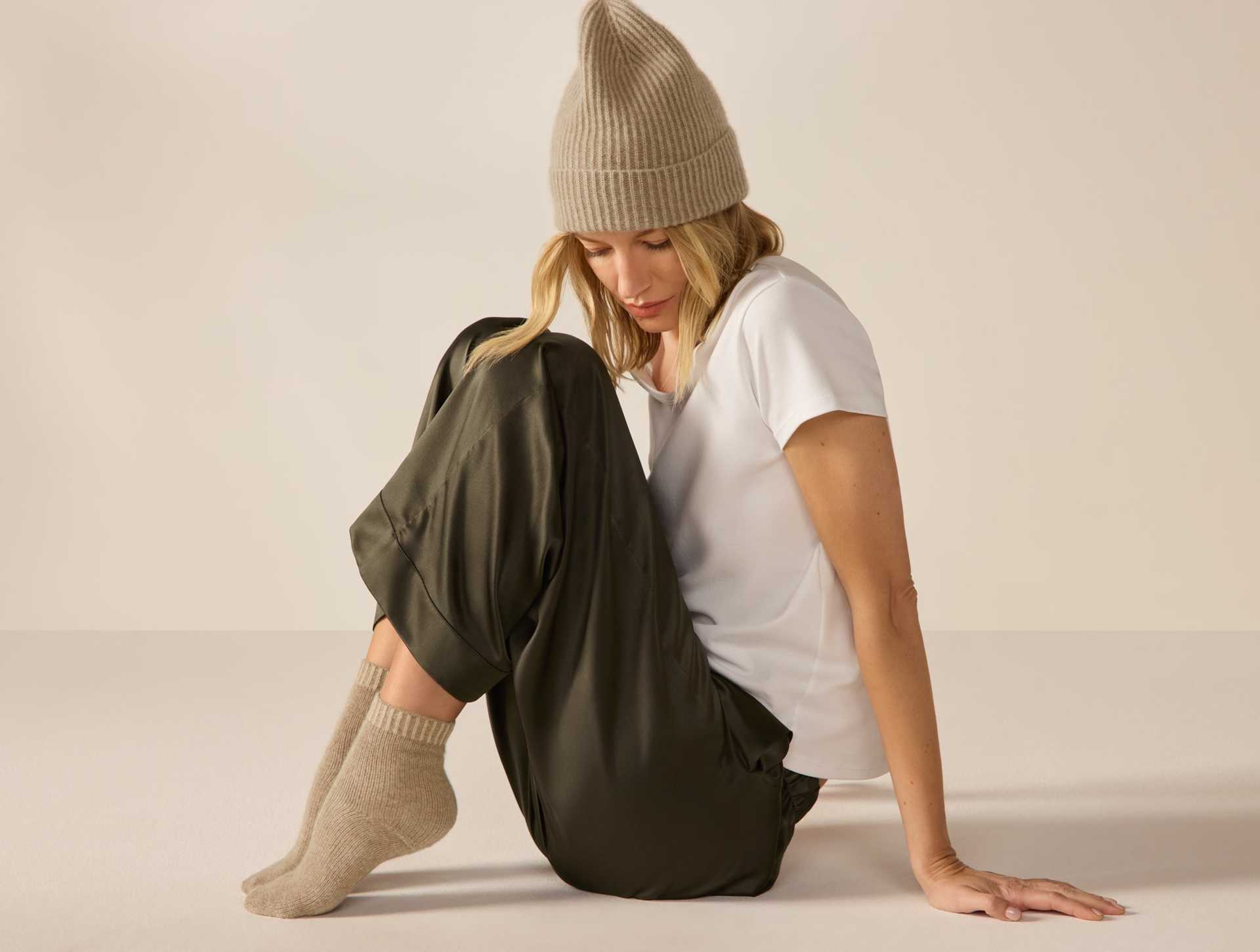
Material and construction shape a beanie’s everyday use. A rib-knit design can stretch to fit comfortably, while a fold-over cuff adds coverage and changes the silhouette. A two-tone cashmere style such as the Whitney Cashmere Beanie illustrates how a practical cold-weather layer can also become part of a personal style. Its material and finish do not determine what it means to the wearer; context and choice do.
That distinction matters. Describing a beanie as casual may be accurate in one context, but it should not become a judgment about the person wearing it. The same principle applies to other accessories: evaluate whether an item meets the needs of the moment, not whether it confirms a stereotype about its wearer.
Reading knitwear without overreading people
People naturally interpret what they see. A bright sweater may seem playful; a dark, fine-knit layer may look restrained. These impressions are part of ordinary social perception, but they are not dependable biographies. Clothing can suggest a mood or intention, yet it cannot establish a person’s character, politics, income, or cultural identity.
That caution is particularly important when a garment appears unfamiliar. A pattern may have a history the observer does not know. A relaxed silhouette may be chosen for comfort, accessibility, or taste. A person may wear a particular item because it was a gift, because it suits the weather, or because it is the clean layer within reach. There is no obligation for clothing to explain itself to strangers.
Useful etiquette rests on a modest distinction: notice the garment, but do not turn an observation into an unsupported conclusion. If the setting requires a decision—whether a hat should be removed, for example—address the relevant norm politely and consistently. If there is no practical reason to comment, silence may be the more respectful response.
For writers, educators, and fashion enthusiasts, precise language helps. “Commonly worn in this setting” is more careful than “people from this culture wear.” “Associated with a particular tradition” leaves room for variation; “the traditional look” can imply a false uniformity. Communities are not style categories, and their clothing practices change over time.
A practical guide to choosing an everyday layer
Choosing knitwear for a particular day can begin with a few straightforward questions. What will the weather be like? How will the day move between indoor and outdoor spaces? Is there a dress expectation, and is it written or simply habitual? How much warmth and freedom of movement are needed? These questions connect comfort to context without turning dressing into a test of conformity.
- Start with the setting. Consider whether the day includes a formal event, a workplace with a clear dress code, a school visit, or a relaxed gathering.
- Plan for changing temperatures. A lighter cardigan may be more adaptable than one heavy layer when conditions shift.
- Check the material and care needs. Fiber content, construction, and washing instructions can affect comfort, longevity, and whether a garment suits frequent wear.
- Think about fit and movement. A good layer should work with the clothes beneath and outerwear above it, without restricting ordinary activity.
- Leave space for personal preference. Color, texture, and silhouette can express taste while still meeting practical needs.
- Ask when a norm is unclear. A straightforward question is often better than guessing or assuming that one person’s preference applies to everyone.
These considerations are guides, not rules. The point is not to make every outfit conform to an imagined standard, but to understand the occasion well enough to make a deliberate choice. A person may reasonably prioritize warmth, mobility, modesty, accessibility, or self-expression. Different priorities can coexist in the same room.
Care as part of a garment’s social life
How a knit is cared for affects how long it can serve its wearer. Gentle handling, appropriate washing, and careful storage can preserve shape and texture, though the right method depends on the fiber and label instructions. Some garments are machine washable; others require more cautious treatment. Following the maker’s guidance is safer than assuming all sweaters behave alike.
Repair is another part of knitwear’s meaning. A mended cuff or a carefully darned hole may be nearly invisible, or it may remain as a sign that the garment has been kept in use. Either way, extending a garment’s life can be a practical alternative to replacing it. It also challenges the idea that clothing must appear perpetually new in order to be presentable.
In some families and communities, knitting and garment repair are shared skills passed between generations. In others, they are hobbies newly learned or simply not part of daily life. No single relationship to making or mending defines a community. Still, the work invested in a garment—whether by hand or through skilled production—can deepen appreciation for its materials and construction.
Thoughtful care supports both personal use and a more considered wardrobe. It invites people to understand what they own, how it performs, and what it takes to maintain. A sweater’s value is not only its appearance on the day it is purchased; it also lies in the years of wear, adaptation, and memory it may accumulate.
Curiosity over certainty
Knitwear moves easily between roles. It can be a weather solution, a work layer, a cherished hand-me-down, a polished element of an outfit, or simply the sweater that feels right that morning. Its cultural signals matter, but they do not operate like fixed rules. Meaning changes with the wearer, the setting, the audience, and the moment.
Understanding dress norms is therefore less about memorizing what a cardigan “means” than learning to pay attention. Notice how a setting communicates expectations. Distinguish practical needs from assumptions. Treat regional and cultural references with care. And remember that the person wearing the garment knows more about its purpose than an observer can infer at a glance.
Everyday layers are modest objects, but they reveal a larger truth about clothing: we dress within shared worlds while making choices of our own. A knit may help someone fit in, stand apart, stay warm, or feel at home. Often it does several things at once. The most useful response is neither to ignore those signals nor to overstate them, but to meet them with context, attention, and respect.